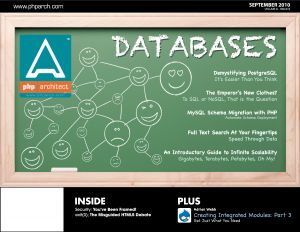
Demystifying PostgreSQL
When working on a LAMP project you may be tempted to choose MySQL for your database. After all, that is what the M stands for. If the recent acquisition of MySQL by ORACLE gives you pause, it’s time to change that stack to LAPP and use PostgreSQL. Although many still have the misconception that PostgreSQL is difficult, that couldn’t be further from the truth. Not only is PostgreSQL completely open, thus preventing any unforeseen acquisition situations, its performance, feature set, and ease of use should put it at the top of your list the next time you choose a database. –by Asher Snyder
An Introductory Guide to Infinite Scalability
Your database is fast now, but will it still be fast when it’s twice the size? Ten times? A thousand? This article covers the basics of keeping any scale database fast with MongoDB. Most of the guide is applicable to relational databases, too, other than a couple sections about MongoDB-specific features such as replication with automatic failover and sharding. –by Kristina Chodorow
MySQL Schema Migration with PHP
In large projects, you are often changing database schemas, but how do you deploy schema changes to other developers, test servers and production servers? This article explains several approaches to deploying your database schema. –by Maxim Antonov
The Emperor’s New Clothes?
NoSQL databases are in vogue this year. How can we cut through the hype and advocacy, and develop some wisdom about using different strategies for data management? –by Bill Karwin
Full Text Search At Your Fingertips
Today’s applications have to handle more data every day, but can our applications handle it? Let’s take a look inside a full text search with Sphinx. –by Dragos Rusu
Drupal Corner: Creating Integrated Modules for Drupal – Part 3
In part 3 of our tutorial series on creating integrated Drupal modules, we will add customized views integration with the CCK module that we developed in the last column. We will expose some of our module CCK data to views, implement two views handlers, and a views plugin that validates input. This module facilitates a path visibility system that I introduced in the July column. –by Adrian Webb
Security Corner: You’ve Been Framed!
Is your site safe from being embedded within a malicious site? –by Arne Blankerts
exit(0): The Misguided HTML5 Debate
Will front-end usage or back-end development decide the fate of Flash and HTML5? –by Marco Tabini
Editorial: It’s All About Choices
We’ve got options, but do we have the details?–by Elizabeth Tucker Long
ElePHPants!
Check out last month’s caption contest winner (Andy Feys). Then, send us a caption and WIN the monthly mystery prize!